"An Advent calendar is a special calendar used to count the days of Advent in anticipation of Christmas" - Wikipedia
It's the most wonderful time of the year!
Thanks to Eric Wastl, I am counting my holidays down in 2020 solving programming puzzles. Advent Of Code is a journey of 25 two-part coding challenges, each delivered in sequence at midnight (starting Dec 1st) all the way to Christmas. If that's not exciting enough for you, all these challenges are connected via a intricate storyline where you save Christmas. Now who doesn't want to do that!
Even though this is the 6th year of this coding tradition, I just discovered it today. I know I am late even for this year but I am determined to catch up and see how far I can go.
I am going to be documenting my progress here, but at the same time, I don't want to ruin the journey for anyone else. This is more in the spirit of knowledge sharing, encouraging some friendly competition and having fun together. I am going to keep it brief, highlight interesting observations if any and leave my code here. Let me know if you have a better or more creative solution because that's what this is all about!
Alright, here we go.
Day 1: Report Repair
⭐Problem Statement
Difficulty: Easy
Given a list of integers,
- Part One requires you to find two numbers which sum upto 2020 and then return their product.
- Part Two requires you to find three numbers which sum upto 2020 and then return their product.
Day 2: Password Philosophy
Problem Statement
Difficulty: Easy
Given a list of strings, find the number of strings which satify a given "policy".
- Part One specifies the policy as a given character count being within a given range.
- Part Two specifies the policy as a given character being present in exacty one of the two given locations.
Day 3: Toboggan Trajectory
⭐Problem Statement
Difficulty: Easy
Pretty straightforward array traversal with little modulo trick to handle the infinite recurrence towards the right.
Day 4: Passport Processing
Problem Statement
Difficulty: Easy
Hardly a thinker. Just a lot of careful coding to pick out "passports" (each being a dictionary key-value pairs) which have necessary keys and values that satisfy certain specified constaints.
Day 5: Binary Boarding
⭐Problem Statement
Difficulty: Easy
Interesting one. The algorithm for deriving the seat id is essentially binary search and part two is a minor extension that is just a slight variation of LeetCode Easy Missing number
.Day 6: Custom Customs
Problem Statement
Difficulty: Easy
Another straightforward one.
- Part one needs you to find the number of questions anyone has answered yes (logical OR).
- Part two needs you to find the number of questions everyone has answered yes (logical AND).
Day 7: Handy Haversacks
⭐Problem Statement
Difficulty: Medium
Converting the list of rules to a more code-consumable form (I chose a dictionary) is an important first part in solving this problem. I went with a recursive solution with memoization for Part One and utilized the concept of recursive grounding for Part two (or atleast that's what I think it is called). In recursive grounding you start off with set of knowns (the answer for bags which cannot contain any other color is 0) and slowly expand your "known" (or grounded) set by computing the plausible "unknowns". Part two cannot be solved if the containment structure is topologically impossible.
Day 8: Handheld Halting
Problem Statement
Difficulty: Easy-Medium
Part one is a step-by-step mimic of code execution following the NOPs and JMPs and keeping track of the accumulator, till you hit a line you have already executed.
For part two, since it's a given that you need only one swap and input is not insanely big, I tried brute-forcing it (try every swap) and it was fast enough! There might be a more optimal way to do it, not entirely sure at this point. Onward for now!
Day 9: Encoding Error
⭐Problem Statement
Difficulty: Medium
Part one - Keep track of the relevant window of sums to check against by progressively adding the entering element's sums and removing the exiting element's sums.
Part two is essentially a variation of LeetCode "Subarray Sum Equals K".
Day 10: Adapter Array
⭐Problem Statement
Difficulty: Medium
Part one - Sort the array. Track the flow making sure the constraints are met and keep track of the differences.
Part two - Finally a chance to write a dynamic programming solution!
Day 11: Seating System
Problem Statement
Difficulty: Medium
The crux of the logic for this problem is in finding the neighbours. Once that's implemented, to compute the next state, all you have to do is iterate through each cell, identify it's neighbourhood occupancy and accordingly update it's own occupancy. Keep iterating from one state to the next till it stabilizes. I am using deepcopy to make a copy of the current state as occupancy changes are done simulataneously and also due to how assignment works in python.
Day 12: Rain Risk
Problem Statement
Difficulty: Medium
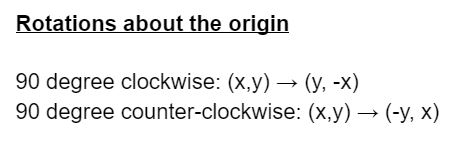
This is all you need to know to solve Day 12.
Note: Non-90 degree angle rotations would make this problem much more difficult.
Day 13: Shuttle Search
⭐Problem Statement
Difficulty: Medium-Hard
Part One is straightforward.
Part Two? I initially thought I will be able sneak through with a bruteforce solution, so I went to watch a movie only to come back and find my program still running :(
Then I starred at the screen and it hit me! I am looking at a system of modulo equations. How do you solve that? Number Theory - Chinese Reminder Theorem and Modulo Inverse (using Fermat's Little Theorem).
Day 14: Docking Data
⭐Problem Statement
Difficulty: Medium-Hard
Part One
- A 0 or 1 in the mask overrides the corresponding bit in value.
- A X in the mask leaves the bit unchanged in the value.
For achieving this transformation, decompose the given mask into an AND mask and an OR mask to be applied one after the other. The AND mask carries over the bits in X as it is and zeros out the positions that need to be overriden. The OR mask then places the appropriate 0/1 (s) in the zeroed out positions.
Part Two
- A 0 in the mask leaves the bit unchanged in the value.
- A 1 in the mask overrides the bit in the value.
- A X in the mask makes it a "schrodinger" bit. Can be a 0 or a 1.
For achieving this transformation, decompose the given mask into an AND mask, an OR mask and a collection of possible OR masks for Xs (capturing the various resolved configurations). The AND mask carries over the bits in 0 as it is and zeros out the positions that need to be overriden. The OR mask then places the ones in the appropriate zeroed out positions. The collection of OR masks for Xs are then be applied to place the resolved 0/1 (s). There would be 2Numbers of Xs possible OR masks
Day 15: Rambunctious Recitation
Problem Statement
Difficulty: Easy
A little breather after a couple of Medium-Hard days. Used a dictionary for memory and just simulated game play.
Day 16: Ticket Translation
⭐Problem Statement
Difficulty: Medium-Hard
A significant part of Part One is parsing all the input and making it code-consumable. But don't worry, Part One in entirety is an investment for Part Two.
In Part One, you have to find all the invalid values. To tackle it more generically (in hindsight of Part Two), I identify all satifying contraints for a given value and report back ones which have zero satifying constaints.
For Part Two, you attempt to utilize your knowledge of these satifying constaints for each value to uniquely identify what the ticket field can be. A value satifying a contraint essentially means that the corresponding field is a potential candidate for being the right assignment. I tackle this iteratively. Values with only one potential candidate can get assigned right away. With these out of the mix, we obtain a reduce problem set. Repeat until we have uniquely identified all assignments or hit a blocker where we conclude that it is not possible.
Day 17: Conway Cubes
Problem Statement
Difficulty: Medium
Brute-forced it.
Can it be done more optimally? I don't know at the moment. Taking the win. Might come back later.
Day 18: Operation Order
Problem Statement
Difficulty: Easy-Medium
Infix expression evaluation - straight out of DSA 101. Enjoyed the trip down memory lane :)
Day 19: Monster Messages
⭐Problem Statement
Difficulty: Easy-Medium
Another one straight out of CS undergrad and this one is from Compilers. These rules essentially form a Formal Grammar. Since the grammar doesn't have any loops you can recursively resolve the rules to pull out a regex expression for "0". After you get the regex, it's as simple as iterating through all the strings and seeing if it's a match.
Part Two attempts to jog a little bit more of your undergrad memory. Do you remember how to expand recursive rules? What regex special characters can you leverage here? Can you take advantage of your knowledge of the length of strings in the input to come up with less complex regex?
Day 20: Jurassic Jigsaw
Problem Statement
Difficulty: Hard
Wow, wasn't this problem jurassic! Easily the most intense day this year.
Part One was not too hard. I didn't even have to put together the whole image since all you need are the corners. Find tiles which have two unmatching edges - meaning two outside edges - and you have found the corners.
Part Two was a mammoth. I am tired, whew. I am going to just let you read the code for this one.
Day 21: Allergen Assessment
Day 22: Crab Combat
Problem Statement
Difficulty: Easy-Medium
Simulated gameplay. Did nothing fancy. Taking the easy win and onward!
Day 23: Crab Cups
⭐Problem Statement
Difficulty: Medium-Hard
Another gameplay simulation. My naive first attempt worked for Part One but Part Two was not all welcoming to that (can't just skate through two consecutive days can I?).
What I needed was a more efficient data structure. Circular and list-like. Hmm. Circular Linked List!
Day 24: Lobby Layout
Problem Statement
Difficulty: Medium-Hard
There are various ways for you to traverse hexagonal grids. I use doubled coordinates as it made the most intuitive sense to me.
Day 25: Combo Breaker
⭐Problem Statement
Difficulty: Easy
I think Eric was feeling a tad generous with it being Christmas and all. Just one part and brute-force-able. Thank you very much!
Having to implement modular exponentiation may have possibly made it a little more demanding but lucky for me, I am using python.
And done. Perfect score. 50/50.
Merry Christmas and happy holidays! 🎄
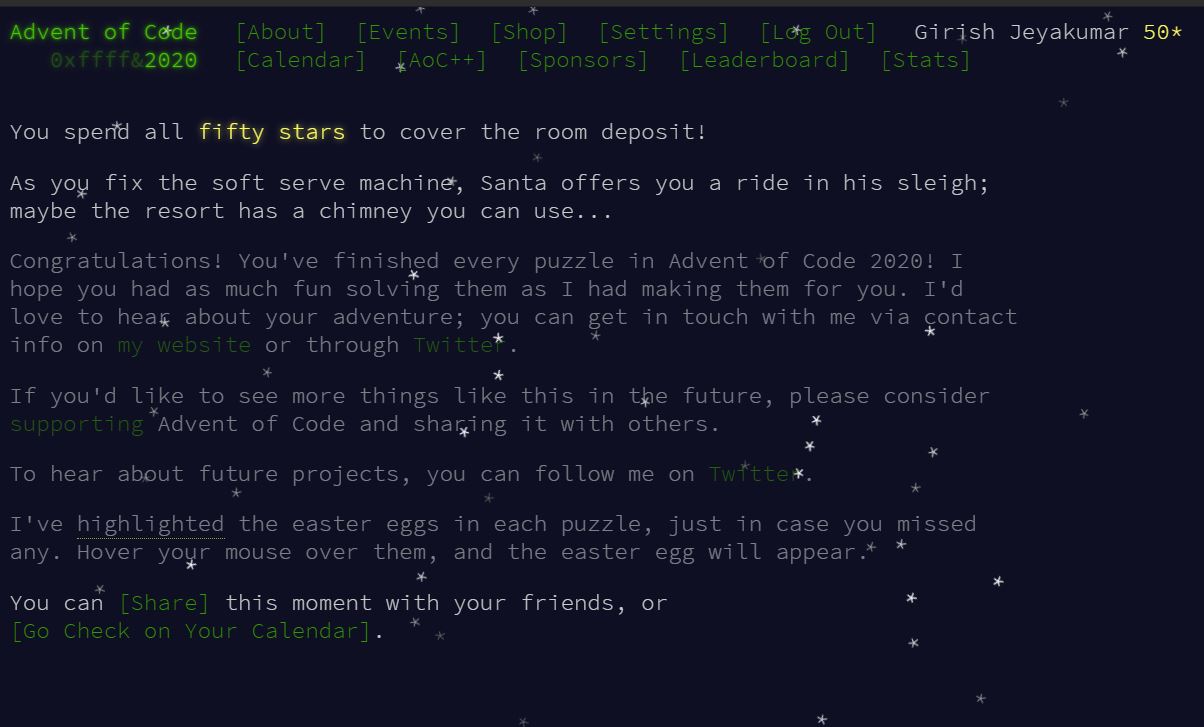
I felt Advent Of Code 2020 to be pretty comprehensive. It was a rather well-rounded 25 (or 10 for me) days of coding. It started off easy but stepped up soon after. There were challenges where the logic was simple but the code got too long. There were also challenges where both the logic and the code got complex (Jurrasic Jigsaw!). My sweet spot are the ones with a tricky logic but simple code. In this respect, I really enjoyed Adapter Array and Shuttle Search. With regard to testing my basics and DSA staples, I had fun with Binary Boarding, Operation Order, Monster Messages and Crab Cups. On an overall, it was good to be working on my DSA skills and also to be coding in Python as we all usher in 2021!
Thanks for reading! Since you got all the way down here, you get a bonus tidbit. Looking to hone your DSA skills? Or maybe just want to experience Advent Of Code 2020 but don't have the time or patience to do the whole thing? Follow my stars!